The Chief and the General
Oglethorpe, Tomochichi, and the Friendship That Built Savannah
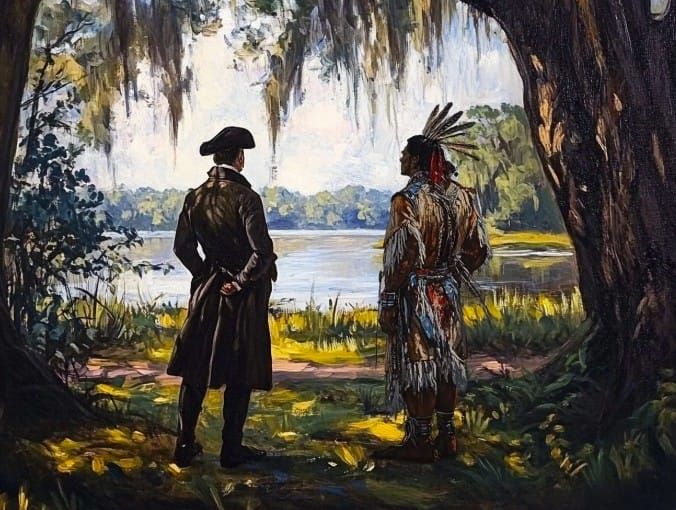
While other colonies took the land by force, Oglethorpe did something almost unheard of — he asked.
And the friendship that followed became one of the great performance multipliers of early America.
There is a familiar and painful pattern to the story of the American colonies and the Native peoples who were already there.
The settlers arrived. They wanted land.
And, more often than not, they simply took it — by trickery, by pressure, or by the gun.
Broken treaties and burning villages followed the frontier wherever it moved.
That is the story we half-expect. And it makes what happened in Georgia all the more astonishing.
We should pause a moment.
This was the age of the Doctrine of Discovery — the sweeping idea, blessed by the Catholic Church in a papal bull as far back as 1452, that Christian powers held a God-given right to claim the lands of non-Christian peoples and to subdue those who lived on them.
The Protestant nations, though they had broken with Rome, quietly built their own justifications for the same.
None of this excuses what was done in its name. But it was the water the whole colonial world swam in — and that is precisely what makes Oglethorpe's choice so radical.
He was not merely being kinder than a few bad neighbours; he was setting himself against one of the foundational assumptions of his entire civilisation.
Because when James Oglethorpe stepped ashore in 1733, he did something the powerful so rarely do.
He asked.
A bluff by the river
In February 1733, Oglethorpe and his first small band of settlers came up the Savannah River and climbed a high bluff on its southern bank. It was the spot he had chosen for his new town.
But it was not empty land. It was never empty land.
Nearby lived a small community of Yamacraw — a band of Creek people — led by an old and remarkable man named Tomochichi.
He was already advanced in years, perhaps approaching ninety, and he carried the weight and wisdom of a long life spent reading both his own people and the strange newcomers from across the sea.
A weaker colony would have seen only an obstacle. Oglethorpe saw a neighbour.
And, in time, a friend.
The woman who stood between two worlds
None of it — not the treaty, not the friendship, not the survival of the colony — would have been possible without one remarkable woman.
Her name was Mary Musgrove. Coosaponakeesa, by birth.
She was born around 1700 to a Creek mother of high standing — kin to the most powerful leaders of the Creek nation — and an English father.
She grew up moving between both worlds: raised in the Creek town of Coweta, then schooled among the English in Carolina.
She belonged, fully, to neither. Which is precisely why she could speak for both.
By the time Oglethorpe arrived, Mary and her husband John ran a trading post near the bluff.
She spoke the language of the Creek and the English of the settlers with equal ease — and, far more rarely, she understood the customs, the courtesies and the unspoken rules that governed each.
She became Oglethorpe's interpreter.
But that word is far too small for what she actually was.
She was his teacher in the ways of the Creek. His guide through their diplomacy. His counsellor on what to say, what to offer, and when simply to listen.
And because of her own kinship with Creek leaders, she carried real authority of her own. She did not merely translate the words — she helped make the peace.
When Oglethorpe and Tomochichi sat down as equals, it was Mary Musgrove who made it possible for two peoples to genuinely hear one another.
Pause on that, because it matters.
The whole friendship — and every dividend that flowed from it, right down to the survival of the colony — rested on one woman willing to stand in the gap between two worlds and hold them together.
That is what connection so often needs. Not just goodwill, but a bridge.
And Mary Musgrove was that bridge.
History has too often remembered her as a mere footnote to Oglethorpe's story. In truth she was one of its principal authors — a connector without whom there would have been no alliance, and quite possibly no Georgia at all.
She deserves to be remembered as a Champion in her own right.
The Choice
Here the Champions Pathway begins to show itself, as clearly as anywhere in Oglethorpe's life.
It began, as it always did, with a Choice.
Oglethorpe chose to engage rather than to conquer.
To sit down with Tomochichi as an equal, not to loom over him as a master. To seek the consent of the Creek for the land he wanted, rather than assume it was already his to take.
In 1733 he negotiated a formal treaty with the Lower Creek. The land for Savannah was granted, not seized. The terms were agreed, not dictated.
To modern ears that may sound like the bare minimum.
In 1733, on a colonial frontier, it was almost revolutionary.
He chose respect. And respect, it turned out, would pay him back a hundredfold.
The Connection
From that first choice grew something deeper — a genuine Connection between the old chief and the English general.
This was no cold, diplomatic arrangement. Oglethorpe and Tomochichi came to trust one another, to rely on one another, to hold a real affection for one another. Tomochichi became the colony's protector and its wisest counsellor; Oglethorpe became the Creek people's advocate and friend.
And in 1734, Oglethorpe did something that sealed it in the eyes of the world.
To England
He brought Tomochichi home to England.
The old chief crossed the Atlantic with his wife Senauki, his young nephew Toonahowi, and several of his people.
And there, in the halls of empire, they were received as honoured guests — presented to King George II and Queen Caroline, feted by the Archbishop of Canterbury, celebrated across London, their portraits painted for posterity.
Imagine how that landed.
At a time when other colonists dismissed Native peoples as savages to be swept aside, here was a Creek chief standing before the King of England as a dignitary and an ally.
Oglethorpe had not merely made a treaty. He had honoured a friend before the whole world.
The Creation
And out of that deep connection came the third movement of the pathway: Creation. Something entirely new.
While other colonies burned along their frontiers — locked in cycles of raid and reprisal, bleeding men and money into endless conflict — Georgia had peace.
And that peace was built on more than goodwill; Oglethorpe wrote fairness into the rules of trade itself.
He set terms to ensure that British merchants could not charge the Creek unreasonable prices or cheat them in the exchange — outlawing the casual exploitation that so often poisoned relations between settlers and Native peoples elsewhere.
Honest dealing, guaranteed rather than hoped for, was part of what kept the friendship whole.
For years, while its neighbours fought, the youngest and most fragile colony in America was kept safe by a friendship.
And when the great test finally came, that friendship saved everything.
Defending America
In 1742, a powerful Spanish force invaded from Florida, aiming to wipe the colony from the map.
Oglethorpe held them back — and at his side, in the fight that secured the future of British America, were the very Native allies whose trust he had earned nine years before.
The peace he had chosen to build was not soft, or sentimental, or naïve. It was, in the hardest possible terms, what allowed Georgia to survive at all.
This is the performance multiplier, written across a whole colony.
Oglethorpe extended dignity and respect — and it came back to him as security, as stability, as survival itself.
Every dividend that other colonies paid for in blood, he earned instead through friendship.
The old chief's last honour
Tomochichi died in 1739, an old, old man — by some accounts around ninety-seven years of age.
He asked to be buried among the English he had come to trust, in the very town he had helped bring into being.
And Oglethorpe honoured him.
Tomochichi was laid to rest in the heart of Savannah, in one of its public squares, with full military honours — and James Oglethorpe himself served as one of the pallbearers, helping to carry his friend to his grave.
Think of what that image says.
The founder of the colony, bearing the coffin of a Native chief through the streets of his planned city, mourning him not as a useful ally but as a friend.
There was no performance in that grief. There was only love.
The ripple, two hundred years on
And here is the strange and beautiful way these stories echo down the years.
Almost exactly two hundred years after Oglethorpe built his colony on friendship with the Native peoples, that same city of Savannah gave the world something new again.
In 1912, a daughter of Savannah named Juliette Gordon Low founded the American Girl Scouts.
It was a movement built on many of the same instincts that had animated Oglethorpe's friendship with Tomochichi — a reverence for the outdoors and the land, a drawing on Native traditions and skills, a belief that young people of every background could be trusted, equipped, and sent out to lead.
A movement of connection across difference. Of capability called forward.
Of girls taught to build something new in the world.
Planted in the very soil Oglethorpe had prepared, in the city his humanity had made possible.
The seeds we plant in friendship have a way of flowering long after we are gone — in places, and in people, we will never live to see.
What it asks of us
The pattern of Oglethorpe's life with the Native peoples is the Champions Pathway in its purest form.
He chose to engage where others chose to conquer.
He built a real connection, honouring Tomochichi as a friend and an equal.
And through that connection he was able to create something entirely new — a colony at peace, an alliance that saved it, and a legacy that still ripples through the city of Savannah today.
And none of it — not the choice, not the connection, not the creation — would have held without Mary Musgrove standing in the middle, holding two worlds together.
Every great act of connection has its bridge-builder. Hers is a name worth remembering.
It would have been so much easier, and so much more ordinary, to take the land by force. Almost everyone else did.
Oglethorpe reached out his hand instead.
And in doing so he proved, one more time, the truth that runs through his whole extraordinary life: that our humanity is not weakness.
It is the most powerful force we have.
Become a Champion
Oglethorpe's story shows that humanity is not a soft alternative to performance.
It is a performance multiplier.
When people are seen, protected and trusted, systems become stronger, not weaker.
If this story stirs something in you, don't let it stay a feeling.
Do what Oglethorpe did — turn it into a choice, a connection and then create the future you want to see, become that future!
- Join the 35Champions site as a free member, and follow the movement as it grows.
- Pay it forward as a paid member, helping young people join the Champions program and become Humanity Champions in their own communities.
- Most of all, choose a pathway of humanity — center your leadership on what makes us human.
Enjoyed this story? Become a Champion, either as a free member, or pay it forward and help fund the next generation of young Champions?
Join as a member, read and share Stories of Humanity, and help fund the next generation of young Champions.
I'd love to hear your reflections below.
Glen
Every effort has been made to ensure historical accuracy; where the record is silent, this telling imagines the likely human moment behind the documented fact. Some connections and consequences are offered as interpretation, not formal historical proof.