Humanity by Design
Center your life on what makes us human, and that humanity flows into everything you build — your laws and your cities alike.
James Oglethorpe on Policy, Cities, and the People they Serve.
For humanity is enterprise and empathy, beauty and belonging, community, proximity, the deep interconnectedness of our lives.
The task is to build that, the whole of what makes us human, into the very structure of a policy or a place — so that the structure in turn enriches, enhances, encourages.
James Oglethorpe's life shows how.
Look closely at what he built — a reform of England's prisons, a colony conceived as a refuge, a city still admired three centuries later — and you find the same thing running through all of it. Not a policy instinct and, separately, a design instinct, but a single underlying ethos that ran through his life, his being — it became his identity — expressed at different scales.
His was a belief in the dignity of the individual, translated first into law, then into land, and into the very layout of a town's streets and squares.
Policy and design were two languages for saying the same thing. And that thing was human.
It began with a book
To understand Oglethorpe the designer, you have to start with a friend and a book.
Robert Castell was a brilliant architect and classical scholar.
In 1728, he published The Villas of the Ancients Illustrated, a study reconstructing how the Romans had planned their villas and towns — an argument, in effect, for order, proportion, communal space and human scale as the foundations of a settlement fit for people to actually live in.
It was a vision of the built environment as something more than shelter.
A town, to Castell, could be a moral and civic organism — designed around community, balance and the common good.
You can see why it seized Oglethorpe.
Here was a man whose whole developing character was oriented toward the flourishing of ordinary people, encountering a philosophy that said the physical world could be deliberately shaped to serve exactly that.
And then Castell died — abandoned in a debtors' prison, in a cell full of smallpox, because he could not pay his debts.
That death, and his friendship, was the prompt for what came next in Oglethorpe's life.
When Oglethorpe later came to build a city from nothing, he did not build it at random.
He built it, in part, as a living memorial to Castell's vision.
Design, for Oglethorpe, began in grief and in friendship — which is to say, in his humanity.
A city built from a deeply human friendship
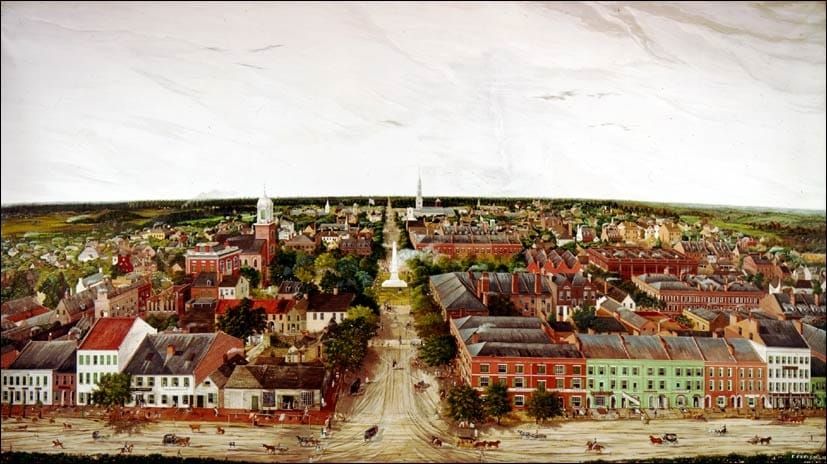
The result was the Oglethorpe Plan for Savannah, laid out in 1733 — and it remains one of the most quietly radical acts of urban design in the history of the Americas.
Its genius lay in a single repeating unit: the ward. Each ward was arranged around a central public square.
Around that square sat larger "trust" lots reserved for civic buildings and churches, and rows of equal residential lots for the settlers.
As the city grew, the pattern simply repeated — square after square after square, each one a self-contained neighbourhood with a shared green heart.
Notice what the design encodes.
The squares made the city walkable, human-scaled and communal — every resident lived a short stroll from a shared civic space that served as marketplace, meeting ground, and green refuge.
The equal lots made a statement about equality, echoing in physical form the very policies Oglethorpe wrote into Georgia's charter: land caps to prevent a landed aristocracy, and a ban on slavery.
And the ward structure knitted defence, governance and daily life into one coherent whole.
This is the crucial point. Savannah's form was not decoration laid over its values.
It was its values. The plan was the policy, rendered in streets and squares.
A city that looked, physically, like the convictions of the man who drew it: ordered, egalitarian, communal, and built around people rather than power.
The motto, the ethos — Not for self, but for others — was not simply a tagline; it was lived through his life.
The policies and designs he enabled came from this life, from him. Not a tool or a technique to be applied, but part of who he was.
Design, here, is simply humanity given a shape you can walk through.
The most admired plan in America
Three hundred years later, the verdict is in.
Savannah is widely regarded as America's first and best-preserved planned city.
Its historic district is one of the largest National Historic Landmark districts in the United States, and one of the most beloved urban environments anywhere in the country.
Urban planners study it. Tourists walk it and, almost without knowing why, feel calmer and more at home in it than in the grid-and-tower cities that came after.
The movement known as New Urbanism — with its emphasis on walkability, mixed use, human scale and public space — has repeatedly pointed back to Oglethorpe's plan as a touchstone.
This is the performance multiplier written into stone and greenery.
Oglethorpe designed for human flourishing, and nearly three centuries later that design is still paying dividends — in the wellbeing of residents, in the life of the streets, in a city that remains, generation after generation, a place people love.
New Champions become the protectors
One of Oglethorpe's public squares held the grave of Tomochichi, the Yamacraw chief whose friendship had kept the young colony alive.
Oglethorpe had buried him there, in the heart of the city, with full military honours — a Native leader laid to rest in one of the very squares that gave Savannah its human scale.
But memory, like design, can be paved over.
In 1883 the city removed the burial mound at the centre of Wright Square and raised in its place a monument to William Washington Gordon, a railroad magnate.
The chief's grave was, in effect, erased for the glory of commerce.
One woman refused to let it stand — and, by a striking irony, she was the railroad magnate's own daughter-in-law.
Nellie Kinzie Gordon, first president of the Georgia Society of the Colonial Dames, campaigned to keep the city's true history alive.
In 1899, she and the Dames set a great granite boulder, hauled from Stone Mountain, in Wright Square as a memorial to Tomochichi, where it still stands.
And the thread runs on.
Nellie's daughter grew up watching her mother fight to keep a Native chief's memory alive in a public square — and that daughter, Juliette Gordon Low, went on in 1912, in that same city, to found the Girl Scouts of the USA, open from the first to girls of every background.
The humanity Oglethorpe had built into Savannah kept flowering, one generation calling it forward in the next.
The salon as policy laboratory
There is a final, easily overlooked stage where policy and design met in Oglethorpe's life: his home.
In his later years, he and Elizabeth turned their homes into one of the great gathering places of the Enlightenment, hosting the sharpest minds of the age.
We usually think of a salon as a social ornament. It was something far more consequential.
The Garden of Eden is how visitors described it.
It was a laboratory of ideas — a place where the thinking that shapes law and society is incubated, argued, refined and passed on.
For it was in exactly this setting, mentoring the next generation, that Oglethorpe helped equip the reformers — Granville Sharp foremost among them — who would carry his convictions into the decades after his death.
The salon was where the baton was prepared for the handover.
Human-centred policy, it turns out, is not only written in parliaments. It is grown in rooms where one generation deliberately hands to the next.
And that, in the end, may be the most human design of all — not a law, or a city, or a colony, but a room where people are brought together, where shared values of humanity are mentored and passed on, and where the next generation is inspired to carry them forward.
We are all, in our own spheres, designing something. The only question is what we choose to build it around.
Become a Champion
Oglethorpe's story shows that humanity is not a soft alternative to performance.
It is a performance multiplier.
When people are seen, protected and trusted, systems become stronger, not weaker.
If this story stirs something in you, don't let it stay a feeling.
Do what Oglethorpe did — turn it into a choice, a connection and then create the future you want to see, become that future!
- Join the 35Champions site as a free member, and follow the movement as it grows.
- Pay it forward as a paid member, helping young people join the Champions program and become Humanity Champions in their own communities.
- Most of all, choose a pathway of humanity — center your leadership on what makes us human.
Enjoyed this story? Become a Champion, either as a free member, or pay it forward and help fund the next generation of young Champions?
Join as a member, read and share Stories of Humanity, and help fund the next generation of young Champions.
I'd love to hear your reflections below.
Glen
Every effort has been made to ensure historical accuracy; where the record is silent, this telling imagines the likely human moment behind the documented fact. Some connections and consequences are offered as interpretation, not formal historical proof.