Finding My Own Ground
Navigating conflict challenged Fred's convictions and sense of belonging. Being part of 35Champions, discovering humility, humanity and the courage to question, he discovered a different path and found his place.
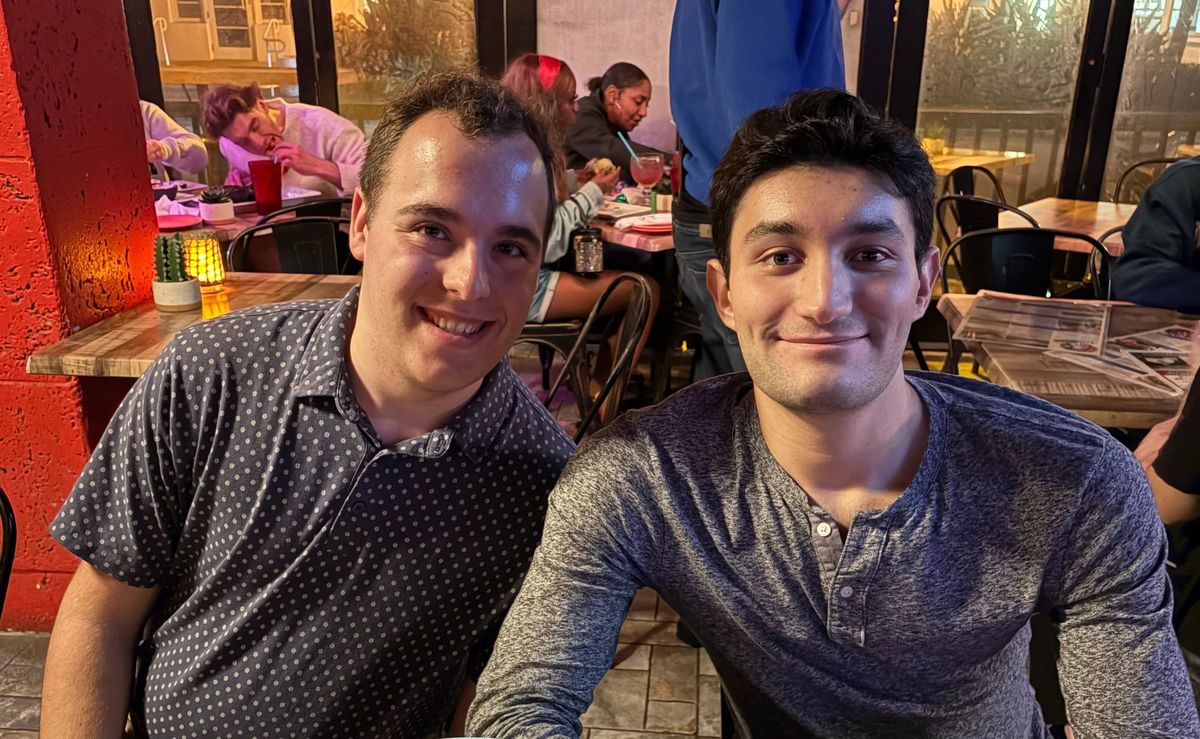
Fred started college set on a career in counterterrorism. A chance dinner pulled him into the Israel/Palestine dialogue scene instead, and he soon found he had no political home: too nuanced for one camp, too suspect for the other.
In this piece, Fred explains how a conversation with former Palestinian Prime Minister Salam Fayyad changed how he saw the conflict, and why he stopped trying to be anyone’s saviour.
He also writes about what 35Champions taught him about humility, and about his work today bringing violence-interruption methods to the West Bank.
By Fred Gale, one of the participants of the 35Champions 2025/26 pilot.
When I started college, I had a very clear script for my life.
I entered the field wanting to do counterterrorism. I wanted threats analyzed, security secured, and problems solved through the lens of protection and statecraft.
It was a neat, orderly way to view the world, cleanly divided into good actors and bad ones, risks and mitigations.
I did not expect that entering that world would leave me politically homeless.
Stepping into the Middle
In truth, I stumbled into the conflict by sheer chance.
At the start of my freshman year, I happened to sit next to the founder, Brandon Leach, of the Collegiate Institute of Middle Eastern Affairs at a dinner.
One conversation led to another, I was hired on, and I rapidly climbed the ranks. Before I knew it, I was deeply embedded in the Israel/Palestine dialogue scene on campus.
Before that dinner, issues like this felt academic. They were things to read about in policy papers or debate in seminar rooms. Suddenly, they were personal, messy, and charged with an intensity that textbooks cannot capture.
Having some Jewish heritage, even as someone who is only a quarter Jewish, added a distinct layer of friction. I found myself navigating spaces where expectations were heavy and rigid. I was not a Zionist in the traditional sense, yet I did not fit comfortably into the standard pro-Palestine camp either.
On one side, expressing nuance while criticizing Israeli policy felt like betrayal to some.
On the other, holding that fraction of a background meant my presence was occasionally met with skepticism by those who demanded absolute ideological conformity.
I felt like I belonged everywhere and nowhere all at once. And I quickly became disillusioned.
The dialogue felt circular and hostile, just people squabbling in a classroom. I realized that at the end of the conversation, no matter how eloquent or sharp it was, people still starved, bombs still fell, and two nations were rapidly tearing each other apart.
The Weight of Saviors and Structures
The turning point came during a lecture where I had the chance to speak directly with Salam Fayyad.
Listening to him talk about governance, economic resilience and institutional development blew open a completely different way of thinking about the conflict.
He was not talking in the loud, abstract slogans that dominated campus debates. He was talking about building infrastructure, establishing transparent public finance, and creating the functional skeleton of a state that could actually stand on its own two feet, rising to independence out of respectability, humility, and proving its utility and humanity to the world, rather than through violent 'revolutionary' struggle.
Fayyad proclaimed a hard truth: the Palestinian people must build their own future through robust institutions, because nobody is coming to save them.
Yet, when I looked around the spaces I inhabited, I found myself surrounded by people who aimed to be nothing but that savior.
That contradiction made me look closely at the room and interrogate my peers. I started wondering how many of them were actually there because they cared, and how many were simply performing a script handed to them by their community or their clergy.
How many truly had stakes in this conflict? And more importantly, what were my stakes?
There is a strange gravity to the savior complex on college campuses and in political advocacy circles. It is intoxicating to believe that you, from thousands of miles away, armed with the right slogans, moral outrage, or policy papers, can swoop in and fix a fracture that has defined generations. It offers a clean sense of purpose. You feel righteous, essential, and heroic.
Sitting across from that mindset, Fayyad's institutionalism felt jarringly unglamorous. He was not offering a megaphone or a revolution. He was offering spreadsheets, tax collection reform, judiciary independence, and municipal infrastructure.
He was arguing that dignity is built in the boring, day-to-day machinery of a functional state, not in the theater of salvation.
If nobody is coming to save them, then the entire premise of the external savior collapses. That realization forced me to strip away my own ego.
If my motivation for getting involved was to rescue people, or to prove my own moral clarity, then I was in it for the wrong reasons.
I had to ask myself uncomfortable questions. Was I projecting my own desire for purpose onto a conflict that did not need my heroism? Was I just another outsider stepping into a space with a clipboard, pretending I had the master key?
Ultimately, holding that institutionalist view put me in a lonely middle ground.
On the more leftist, pro-Palestine side of campus, focusing on technocratic institutionalism was often dismissed as too little, too late, a distraction from radical political transformation.
On the Zionist side, the very idea of building sovereign Palestinian state institutions was treated as a non-starter.
I was too institutional for the activists and too radical for the establishment.
It was around this time that I was introduced to J-Street, which offered a rare space where nuance did not have to mean silence.
The Lesson of Humility
Navigating that ideological crossfire could easily have made me defensive or cynical.
What saved me, I think, was 35Champions and its founder, Glen Ford, whose transformative experiences in post-genocide Rwanda reshaped how I understand structural healing and reconciliation.
My time with 35Champions taught me a kind of humbleness and humility that I desperately needed.
It gave me the permission, and the courage, to admit when I was wrong, to acknowledge that I simply did not know enough, and to embrace the discomfort of continuous learning.
Instead of rushing to defend a fragile ego, I learned how to step back, read more deeply, listen more carefully, and let my convictions be shaped by reality rather than ideology.
That intellectual humility empowered me to educate myself properly, moving past the comfortable certainty of slogans into the difficult,unglamorous work of actual policy.
More than that, this conflict introduced me to the idea of collective liberation: the truth that we are not free until we are all free, because we are one human family.
That principle was deeply imbued in me by 35Champions, drawing directly from Glen’s insights on what it takes to rebuild a society from the ashes of division.
It changed how I move through the world. It taught me to strip myself of both unconscious and conscious inhumanity, and to ruthlessly interrogate every single project I join.
Now, before I step into any room, I force myself to answer hard questions.
- Why do I, Frederick Gale, deserve this seat at the table over another?
- What do I actually contribute?
- Is it ethical for me to be here?
Building Where There Is No Door
What kept me tethered to the work was shifting away from the posture of a savior and moving toward the posture of an ally, a builder, and a technician.
Institutions do not care about your moral purity. They care about endurance. They care about transparent budgets, reliable public services, and systems that protect ordinary people when the political winds shift.
That evolution is no longer just theoretical.
Today, I am in the process of applying for grants and building a team to implement Chicago CRED approaches in the West Bank, translating ideas of community-level violence interruption and structural stabilization into a different context.
It is not about saving anyone. It is about working alongside local partners to build community-level infrastructure, treat violence as a public health crisis, and establish structural stabilization that communities can own and operate themselves.
I do not need nor deserve to be a savior. I just need to be a reliable brick in a wall that others are building.
I recognize that the wall will continue building long after me, and my brick one day may turn back to dust.
Looking back, I realize I did not get here on my own.
My village, including CIMEA, Peace Works, 35Champions, and the many academic mentors who guided me along the way, gave me the confidence to develop and stand tall in my own views, even when those views did not fit neatly into anyone else's box.
They gave me more than just advice. They gave me the lexicon to coalition-build, to understand how a team actually works, and to recognize how I fit differently into different teams depending on what the mission demands.
Most importantly, they taught me how to punch through the wall where there is no door.
I did not end up doing the traditional counterterrorism work I thought I wanted when I first started college. I found something harder, messier, and far more meaningful.
I am still learning how to navigate the spaces between rigid camps.
But I no longer feel homeless. I am simply building my own house.
 Glen Ford
 Glen Ford
 Glen Ford
Enjoyed this story? Become a Champion, either as a free member, or pay it forward and help fund the next generation of young Champions.