Fred - Champions Journey in the Making
Becoming a better friend and more relaxed in his relationships
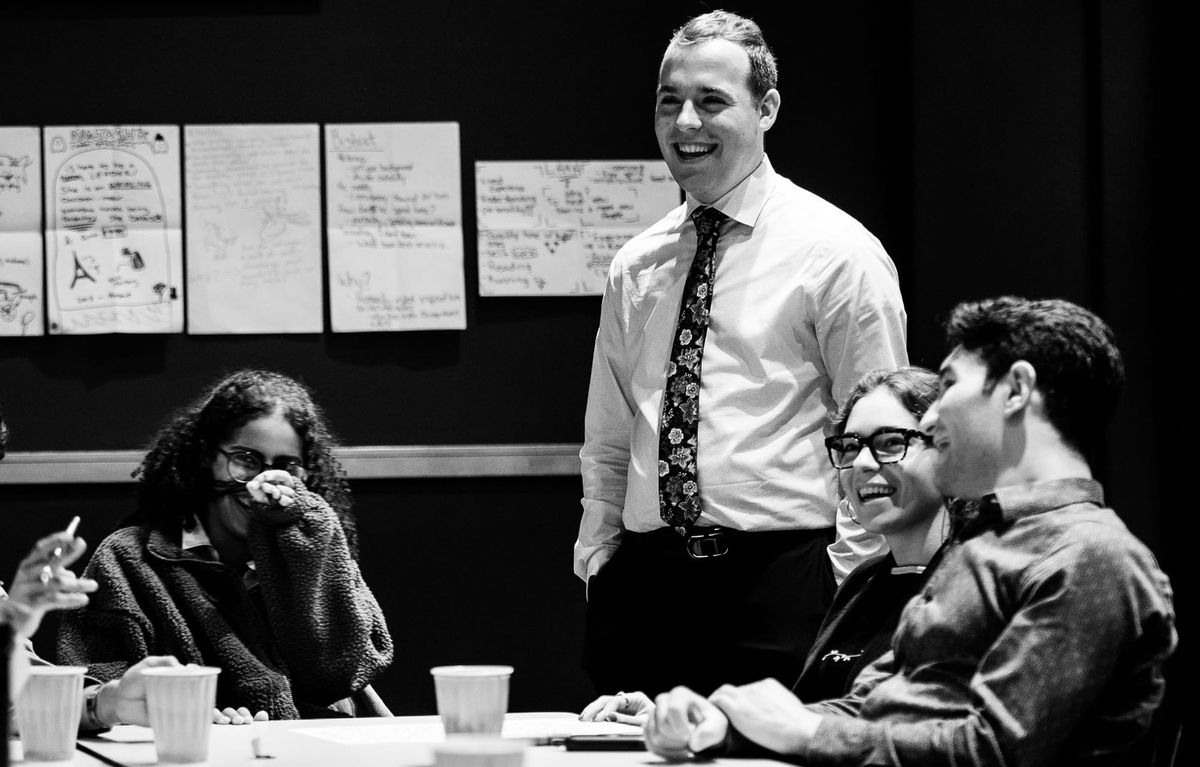
Fred joined the Champions 2025/26 pilot program at an early but important stage in his leadership journey.
A sophomore at American University in Washington, DC, Fred was studying International Studies, with a particular interest in foreign policy, national security and the Middle East.
Originally from New Jersey, he describes himself as having been a “very bookish” child — someone drawn from a young age to history, ideas and the bigger questions shaping society.
Join as a member, read and share Stories of Humanity, and help fund the next generation of young Champions.
For much of his life, Fred imagined becoming a teacher. He saw education, especially civic education, as a way to serve others: helping people understand the world around them, think more clearly, and participate more fully in society. That instinct did not disappear when his academic interests shifted toward international affairs. It simply found a new path.
Through CIMEA — the Collegiate Institute for Middle East Affairs — Fred became involved in student leadership, supporting chapter development and mentoring younger students.
Even before Champions, there was already a strong sense that Fred wanted to help others grow. His motivation was not simply to build his résumé, but to become the kind of person who could make a meaningful contribution.
Fred also brings a personal understanding of the value of opportunity.
He is a triplet, with two sisters also in higher education, and all three are first-generation college students. He speaks with appreciation about the way his parents encouraged education because they wanted their children to have possibilities they themselves had not fully been given.
That background helps explain why learning, mentoring and leadership matter so much to him.
When Fred first joined 35Champions, he was honest about what he was looking for. He had grown as a leader during his freshman year, but wanted to strengthen both his confidence and his practical leadership skills.
He was beginning to move toward “upperclassman status” and asking bigger questions: Who do I want to become? How do I want to lead? What kind of impact can I have?
What makes Fred’s story compelling is that he did not arrive lacking ambition.
Quite the opposite. He arrived as a thoughtful, capable and already engaged young leader.
But he also carried an assumption many young leaders absorb: that leadership means being constantly “on” — always assertive, always pushing, always proving oneself.
In his own words, he had thought that if a student leader was not aggressive or forceful, they might be seen as weak.
Champions began to challenge that belief.
Join as a member, read and share Stories of Humanity, and help fund the next generation of young Champions.
Fred started to discover that leadership is not one-size-fits-all.
Fred comments on his Champions Journey, February 2026
He saw that different people bring different energies, strengths and styles; that delegation is not weakness; and that relaxing into leadership can make a team stronger, not weaker.
He began to understand that good leadership is not about dominating a room, but about knowing people well enough to help them contribute.
Fred particularly valued the group-based, interactive nature of the programme. He had expected something closer to a classroom lecture, but instead found himself building trust with other students, reflecting on team dynamics and thinking about how to take practical models back to his own team.
One of his immediate intentions was simple but significant: to ask better questions — “Why are you here? What are your interests?” That marks an important shift: from leading by assumption to leading through understanding.
Fred’s growth also reached deeper than leadership technique.
The Four Stages of Humanity model developed by Champions gave him language for something personal and uncomfortable: the unconscious bias and unconscious ignorance he recognised in himself as he entered the field of international affairs.
Rather than treating that as a failure, he saw it as part of a process of unlearning.
Champions helped him begin to confront not only how he leads others, but how he understands himself, his field and the people affected by the policies he hopes to study or influence.
That is especially significant because Fred had already noticed a problem in his chosen field. In international affairs and Middle East policy, he observed that people can become overly focused on credentials, background and policy expertise, while losing sight of the human beings they are ultimately meant to serve.
That insight connects directly with the heart of Champions: leadership must never become detached from humanity.
The early results are encouraging.

Fred describes his leadership growth as “night-and-day.”
But perhaps even more importantly, the impact has moved beyond formal leadership roles. He says he has become more relaxed, happier, better in class, a better friend and more grounded in his family relationships.
Join as a member, read and share Stories of Humanity, and help fund the next generation of young Champions.
He has begun to see that leadership is not confined to organisations, titles or professional settings. People lead in friend groups, classrooms, families and everyday interactions.
Fred’s Champions journey is still beginning. He is not being presented as a finished story — and that is part of the strength of his example.
He represents the kind of young person Champions is designed to support: thoughtful, curious, ambitious, open to challenge and willing to grow.
Already, Fred has begun to move from pressure to confidence, from assertion to trust, from credentials to humanity, and from a narrow view of leadership to a fuller understanding of the person he is becoming.
His own commitment captures the promise of the journey ahead: to keep an open mind, to keep growing with the cohort, and to remain open to opportunities he may not yet be able to imagine.
What Fred’s story means for us
Fred’s story is still being written — and that is why it matters.
He reminds us that leadership does not begin when someone has all the answers.
It begins much earlier: in curiosity, uncertainty, ambition, pressure, and the desire to make a difference before we fully know how.
Fred came to Champions already thoughtful, capable and motivated. He cared about education, civic life, international affairs and the wider world. But like many young leaders, he had absorbed the idea that leadership means being constantly “on” — assertive, forceful, always proving yourself.
His journey shows that leadership can become something deeper, calmer and more human.
Fred’s story challenges the myth that strength means pressure.
Sometimes growth begins when we learn to relax, to delegate, to trust others, and to stop confusing control with leadership. A confident leader does not need to dominate every room. A true leader helps others find their place in it — enabling others as well as leading from the front.
His story also reminds us that self-awareness is not weakness. Fred’s willingness to recognise unconscious bias in himself is not a mark against him; it is a sign of maturity. Humanity grows when we become willing to see what we did not previously see, and to unlearn what no longer serves us.
Join as a member, read and share Stories of Humanity, and help fund the next generation of young Champions.
Humility gives leadership strength and depth.
This is especially important in fields like international affairs, politics and public life, where knowledge, credentials and expertise matter — but are never enough. Policies affect people. Decisions affect lives. Leadership detached from humanity can easily become abstract, technical or self-serving.
Fred’s story is a reminder that leadership is not confined to titles, organisations or careers. We lead in classrooms, friendships, families, teams and everyday conversations. The way we show up matters — how we show up, and who we become.
Fred’s Champions journey is just beginning, but already it points to something powerful: when young people are given space to reflect, tools to grow, and a community that believes in them, they do not simply become better leaders.
They become more grounded people, more trusted friends, and more human leaders.
And that is where real change begins.