Be a Man: The Champions Story of Freddy Mutanguha
At eighteen, Freddy lost almost his entire family. His mother's last words: "If you survive, be a man". This is his story.
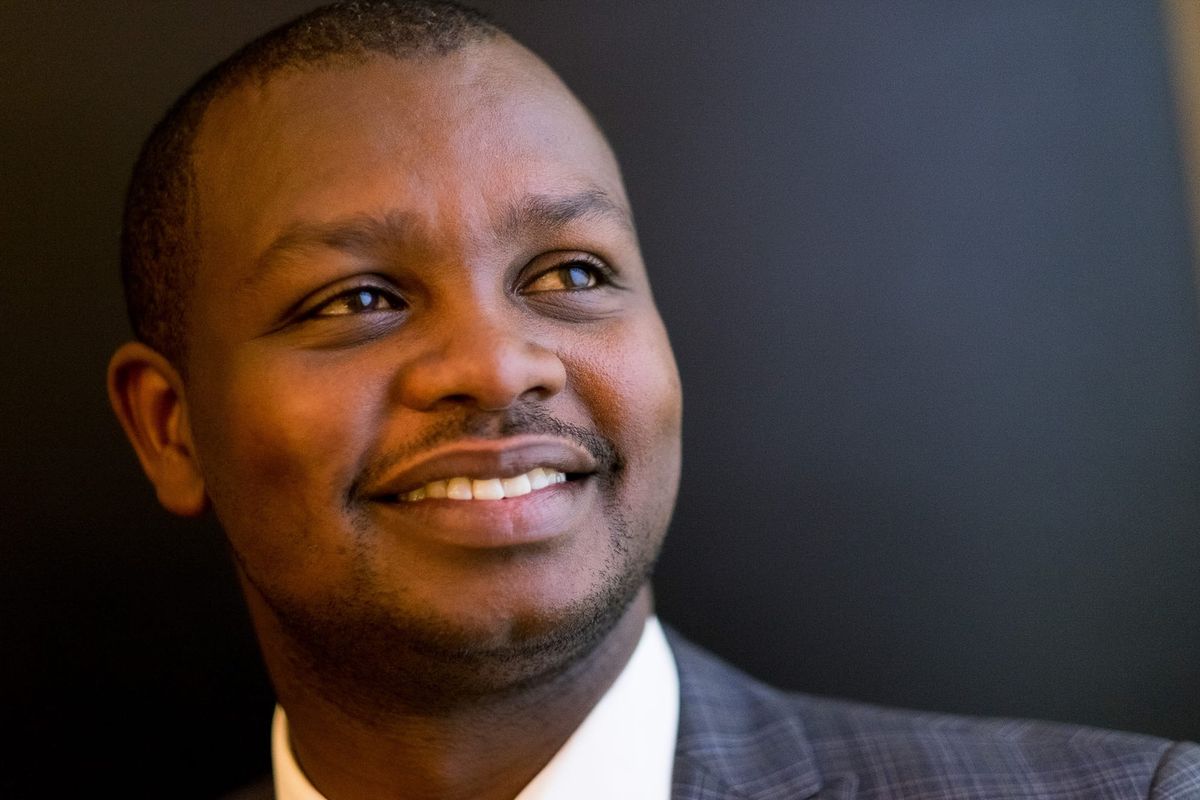
The last words Freddy heard from his mother were:
If you survive, be a man
It's difficult to convey the emotion on that evening, in April 1994, when Freddy last saw his mother.
Her words set him on a road from survivor to one of the world's great champions of peace, and champions of humanity — demonstrating what it means to be human.
This is his Champions Story of Humanity.
Some of the stories I tell in this series I have pieced together from across the centuries, from the outside, as a student of a life long past.
This one I tell from the inside.
I was privileged to join Freddy to commemorate the 10th anniversary of this moment, in April 2004 for an evening vigil. I was the only international person, with Freddy, his surviving sister, and some friends.
I have also had the privilege of walking beside Freddy for more than twenty years — from the day in 2004 when we began, side by side, to help build the Kigali Genocide Memorial, through two decades of work together across Africa and around the world.
I have watched, up close, what a single human being can do with the very worst that life can hand them.
If you want to see the Champions Pathway not as a theory on a page but as a living, breathing human being, you could not find a clearer example than Freddy.
But to understand the choices he made, we have to begin where his world ended.
How a country was taught to hate
For most of its history, Rwanda was not a country divided against itself.
The Hutu, the Tutsi and the Twa lived together, largely in harmony, for centuries.
They shared one language, one culture, one faith. They intermarried. The old categories were more about social standing than about blood — fluid enough that a person could move between them as their fortunes changed.
There were no hard lines.
The hard lines were drawn for them, from the outside.
When European colonial powers took control in the early twentieth century, they set about cementing those loose social categories into rigid, permanent ethnic identities — and, infamously, stamped them onto identity cards, so that every Rwandan now carried a label that could never be shed, passed from one generation to the next.
It was division by design, imported from Europe, which had cultivated bloody hatred and division in Europe and elsewhere for centuries.
This led to systemic prejudice, and over the decades that followed, led to animosity, resentment, then anger and hatred, and then terrible, terrible and mindless violence against innocent people.
We should pause here, because how that division was manufactured matters.
When the colonists first took control — the Germans, and then, after the First World War, the Belgians — they reached for a piece of pseudo-science known as the Hamitic theory to sort the people they now ruled.
They cast the Tutsi, who were the ruling class, as the more "civilised" race, closer to Europeans; and the Hutu, the working majority, mostly subsistence farmers, as lesser — "sub-human" Black Africans.
This was the same poisonous logic we met in the earlier posts on Oglethorpe and Benezet: the Doctrine of Discovery, the religious justification that had been used to bless the enslavement of Africans, now dressed in new language and turned upon a single people.
They applied the ideology of a lie to justify prejudice, where none had existed.
Around some 70 years later, it led to one of the swiftest slaughters in human history: the 1994 genocide against the Tutsi.
In the spring of 1994, in just one hundred days, around a million people were murdered, in a population of around 10 million.
And the most chilling thing of all is who did the killing.
This was not a distant army. It was neighbours turning on neighbours, colleagues on colleagues, sometimes family on family — people who had lived side by side for generations, now set upon one another by a hatred that had been decades in the making.
Into that hundred days walked a boy of eighteen named Freddy.
If you survive, be a man
Freddy lost almost everyone.
His parents. Four of his five sisters. His extended family.
He hid nearby as it happened — close enough to hear his own family being killed, and to be able to do nothing at all. His sisters were murdered with a cruelty it serves no purpose to detail here; what matters is that a teenage boy carried the sound of that day inside him for the rest of his life.
But the day before, in the middle of the gathering horror, his mother did two things he has never forgotten.
The first was small, and almost unbearably tender.
She brought him food — vegetables, and passion fruit. It was the last meal they would ever share. To this day, the taste of passion fruit brings her back to him: a simple, aching reminder of a mother's love in the midst of unimaginable loss.
The second was a request. Knowing what was coming, she looked at her son and said:
If you survive, be a man
In his culture those words carry great weight.
They are not about pride or hardness. They are about strength, and responsibility, and standing up — even when you are utterly alone.
She could give him no protection, no future, no safety.
What she could give him was a charge: a reason to live, and a way to live.
She had no hope. They had used all their money and food to buy time from the killers. Tomorrow would be the end. She would never see her boy again, and she knew.
Freddy was her hope. That if he survived, he would be someone, he would be a man, someone she would want to call her son.
It would take him years to understand everything she meant. But from that moment, those five words became the compass of his whole life.
I'll die with you
Freddy survived because of a choice — not only his own, but another's.
His mother had urged him to hide with a childhood friend, a Hutu boy named Jean Pierre.
To shelter a Tutsi in those days was to risk death; anyone found doing it could be killed alongside the one they hid.
Jean Pierre knew that. And when Freddy came to him, this is what his friend said:
Freddy, I'll die with you.
Sit with that. A child, in the middle of a machine built to turn neighbour against neighbour, looked at his terrified friend and chose connection over fear, humanity over hatred, at the possible cost of his own life.
It is one of the purest acts of courage in this whole story — and it is the reason Freddy is alive to tell it.
In the language of Champions, Jean Pierre was a Protector — one of those rare people who stands in the gap when hatred demands that everyone step aside.
Everything that followed — every life Freddy would go on to touch, every wound he would help to heal, across Rwanda and far beyond — flowed from one friend's refusal to let the hatred decide who he would be.
The long walk back
When the killing finally stopped, Freddy was left adrift in a shattered world. His village was gone. His family was gone. He was, by every ordinary measure, lost and alone.
But his mother's words kept echoing.
Be a man.
And slowly he came to understand that being a man did not mean simply staying alive. It meant rebuilding. It meant finding a purpose in the ruins.
And the first step he could see toward healing was almost ordinary in its courage: he decided to go back to school.
There, among others who had survived the same unspeakable thing, he discovered something that would shape the rest of his life — that pain shared begins to lift.
Among fellow survivors, in the simple act of telling their stories to one another, he found a kind of collective therapy, a place of comfort and mutual support for a whole generation scarred by the same trauma.
Out of that discovery he helped found the Association of Student Survivors of the Genocide, a grassroots movement that grew and grew, built on nothing more complicated, or more powerful, than human beings choosing to heal together.
He did not know it yet, but he had already begun to live out the deepest principle of what we would later call the Champions Pathway: that when we share our common humanity — when we truly listen, and build honest, empathetic connection — we not only heal ourselves, we strengthen the humanity in everyone around us.
Forgiveness, the gift he gave himself
The hardest part of Freddy's journey was not survival. It was forgiveness.
And it did not come quickly. It took him something close to seventeen years.
For a long time he carried the anger, the bitterness, the hopelessness — as anyone would.
What began to change him was a realisation, hard-won and profound: that forgiveness, if it ever came, would not be a gift to the people who had destroyed his family.
It would be a gift he gave himself.
The bitterness was a weight only he was carrying, and he came to fear that if he did not set it down, he would pass it on — that his own children might inherit the hatred, and carry the cycle forward into another generation.
So he chose, deliberately and at great cost, to lay it down. Not as a feeling that washed over him, but as an act of will.
He was relentless about the truth.
He even sought out Samson, the man who had killed his family. But there was no reckoning there — no accountability, no remorse, nothing.
Forgiveness, Freddy learned, is not always met, or earned, or returned.
And yet, in a different encounter, with a different perpetrator — a man who confessed his part, who admitted he had revealed where Freddy's family was hiding — Freddy found he could forgive.
It taught him that forgiveness is not a single blanket act but something nuanced, personal, and freely chosen: not owed to anyone, and all the more powerful for that.
This is why Champions never treats forgiveness as forgetting, or humanity as weakness. Forgiveness without truth becomes denial. Accountability without humanity becomes vengeance. Freddy’s life holds the harder balance.
The human spark
There is one thing Freddy did that I still find almost impossible to comprehend.
He took perpetrators from his own village — men he knew, men who had killed his neighbours, men who had been his tormentors — and he brought them to the Kigali Genocide Memorial.
He has been honest about how hard that was, how deeply conflicted he felt.
But he believed it was necessary — for his own peace, and to set an example of what another way might look like. And standing there, among the stark evidence of what they had done, something extraordinary happened.
Some of them broke down and wept.
In that moment, Freddy saw something he has never let go of: that even in men who had done monstrous things, there was still a human spark. Not an excuse. Not a forgetting. But a recognition — that the capacity for change exists even in the most unexpected places, and that if hatred can be taught, so can its opposite.
That was the moment his own healing turned outward, and became a mission.
From survivor to builder
In 2004, ten years after the genocide, Freddy and I began to work together.
It was during the building of the Kigali Genocide Memorial — the resting place of a quarter of a million victims — and Freddy started as a team leader for genocide documentation, painstaking, emotionally shattering work.
His dedication and his quiet strength were unmistakable.
He rose quickly: country director by 2006, and today the CEO of the Aegis Trust and the Director of the Memorial itself, overseeing its threefold mission of remembrance, education and healing. He also chairs Miracle Corner Rwanda, pouring himself into the empowerment of the next generation.
What we began as one project became more than twenty years of shared, life-saving work as part of the team at Aegis Trust — across Africa, Australia and the United States.
And so much of the Champions methodology that my friend Steve Kelly and I would go on to develop draws its deepest lessons directly from what Rwanda has done since 1994.
Because think about what this country has achieved.
After losing a million people in a hundred days, Rwanda chose the almost unthinkable path of reconciliation.
Today survivors, perpetrators and their families live side by side — peacefully, and in many cases working together to rebuild.
Rwanda went further still: it wove peace education, with its focus on empathy, critical thinking and personal responsibility, into the national curriculum across every subject, from biology to mathematics — a deliberate effort to grow a culture of peace in every child, from the ground up.
It stands as living proof to the whole world that even the most unbreakable-seeming cycles of hatred can, in fact, be broken.
Like every true Champion, Freddy did not stop at feeling. He created — communities of survivors, places of memory, programmes of peace education, and pathways of healing others could walk.
The ripple that crossed a border
Freddy's story could have ended as a Rwandan story. It did not.
In 2014 he travelled to the Central African Republic, a nation caught in its own cycle of conflict and humanitarian crisis.
He walked through refugee camps and saw the same devastation, the same hopelessness, that had gripped Rwanda twenty years before.
It was a painful echo. But it also showed him something: that his testimony — his own story, told plainly and from the heart — had the power to heal, and even to save lives.
There is one moment he carries from that time. A woman in a church, having listened to Freddy speak, found within herself the strength to forgive the man who had killed her own son.
That is the whole lesson, right there.
It is not the experts with their theories who spark the deepest change. It is people like Freddy — survivors who find the courage to share their most personal pain — whose stories reach across every barrier and unlock something in another human heart.
Freddy came to understand that his own life had a meaning and a purpose he could not have imagined in 1994: that in giving hope to others, he was also, slowly, healing his own wounds.
It did not erase what he had lost. But it gave the loss a purpose.
What Freddy teaches us
There is a principle at the heart of the Champions methodology we call the multiplier effect — sometimes known as the "3.5% rule."
The research behind it suggests that a relatively small group of deeply committed people, perhaps as few as three and a half per cent of a population, can become the critical mass, the tipping point, that shifts a whole community, a whole culture, a whole nation.
It is not about grand gestures from a famous few.
It is about ordinary people activating and strengthening their own humanity, making courageous choices, and letting those choices carry forward and outward — from one life, to the next, to the next.
Freddy is living proof of it.
A boy who lost almost everything, who could have been consumed by an entirely justified rage, chose instead — again and again, over decades — to heal, to connect, to forgive, and to build.
And those choices did not stay in one shattered village. They moved across a nation, and then across borders, and they are still rippling now.
His life carries the simplest and most demanding message there is: that no matter what your past holds, no matter what has been done to you, you retain the power to choose who you become.
And with that power comes a responsibility — not only for what we do, but for what we fail to do.
His mother asked him, in the last hours she had, to be a man.
He has spent his life answering her — and in doing so, he has shown the rest of us what it looks like to be fully, courageously, human.
Oglethorpe’s motto was “Not for ourselves, but for others.” Freddy’s mother gave him the same truth in different words: “If you survive, be a man.”
In both, life becomes a responsibility to carry humanity forward.
Or as we say in Champions, developing the capacity to act for the good of others.
Join as a member, read and share Stories of Humanity, and help fund the next generation of young Champions.
Become a Champion
Freddy's story shows that our humanity is a fragile thing, and it can easily destroyed. But, it is also the most powerful force we have.
When people choose empathy over fear, connection over division, and forgiveness over the cycle of hate, whole nations can be rebuilt.
If this story stirs something in you, don't let it stay a feeling.
Do what Freddy did — turn it into a choice, a connection, and then create the future you want to see; become that future.
- Join the 35Champions site as a free member, and follow the movement as it grows.
- Pay it forward as a paid member, helping young people join the Champions program and become Humanity Champions in their own communities.
- Most of all, choose a pathway of humanity — and make the courageous, human choices, one at a time.
Join as a member, read and share Stories of Humanity, and help fund the next generation of young Champions.
I'd love to hear your reflections below.
Glen
This account is drawn from Freddy Mutanguha's own testimony. It is shared with the deepest respect for the memory of those who were lost, and for the survivors who carry their stories forward so that the world will not forget.