A Story of Humanity - Anne Carter
This is a short post about a story of humanity — or perhaps several stories, all connected to the same place.
A few weeks ago, I met Anne in her home town of Cedar Rapids, Iowa, together with my friend Andy from the UK.
After a lovely lunch and conversation, Anne invited us back to her family home. She wanted to show us something across the street.
A driveway, yes, Anne asked if she could show me and my friend Andy her driveway. Her home was just a few blocks away.
As Anne explained why, an ordinary strip of concrete became something else entirely: a story about how seemingly small childhood experiences can stay with us and shape who we become.
Anne speaks about her childhood memories of not 'crossing the line'
There is much more to Anne’s family story.
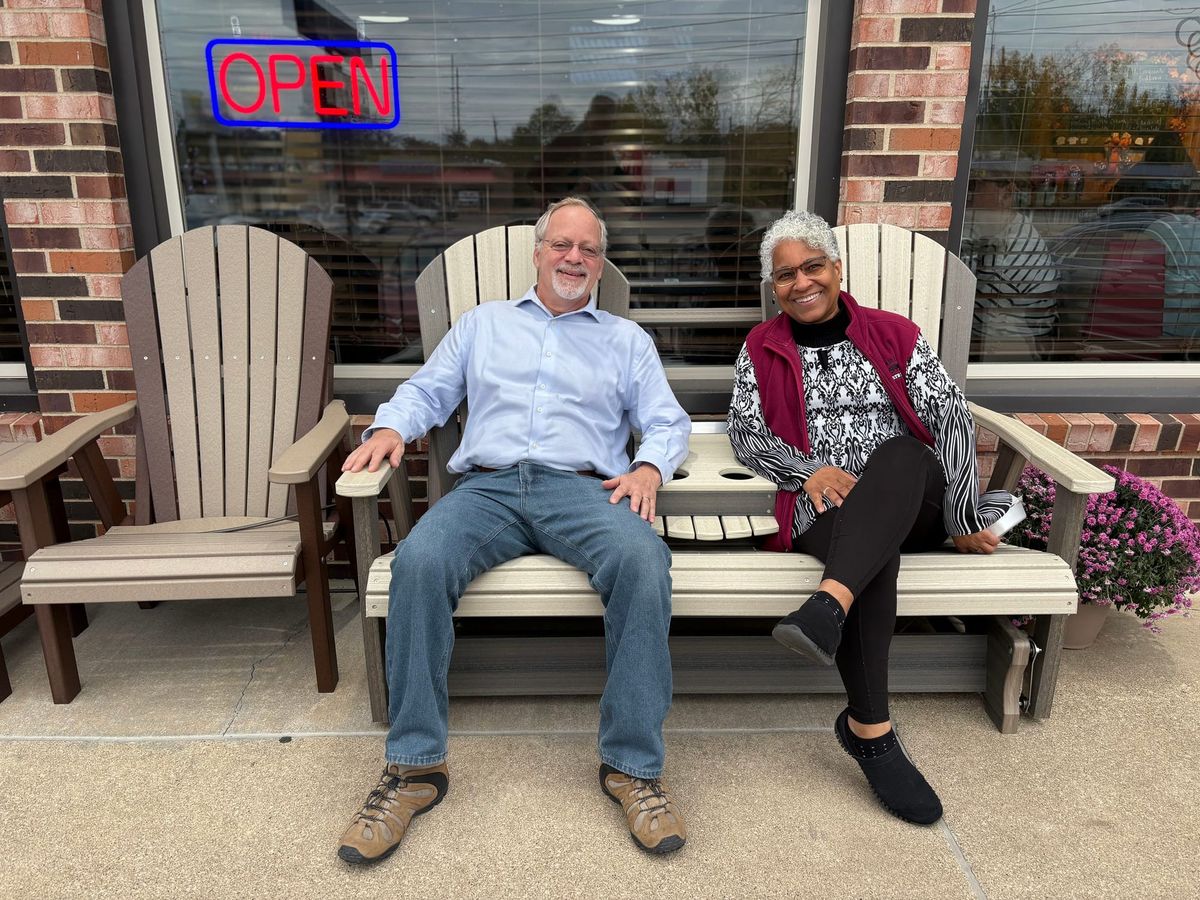
Her parents, Percy and Lileah Harris, came to Cedar Rapids many decades ago. The picture at the top of this post, of Anne with Robert Becker, tells part of it.
Robert’s father played an important role in welcoming Percy and Lileah to Cedar Rapids, providing Percy with space to run his medical practice at a time when few others would.
Decades later, Anne and Robert are standing together, smiling.
Anne Carter — Crossing the Line
Anne Carter stands outside her family home in Cedar Rapids, Iowa, looking across the street at a driveway.
To anyone else, it might look entirely ordinary. A strip of concrete. A neighbour’s property. A route children might take on their way to school.
For Anne, it represents a line she had been taught not to cross.
Anne’s parents built their family home and moved into it just before she was born. But before they were able to buy the property, some people in the neighbourhood had tried to stop the sale. A petition had circulated against them.
Cedar Rapids, like many American cities, carried a history of racial discrimination in housing. For families like Anne's, where they could live was not always simply a matter of choice.
Anne was the eighth child in her family. By the time she went to kindergarten, her elementary school was just behind the neighbouring properties.
Some neighbours allowed the Carter children to take a shortcut across their driveways and yards, making the walk to school simple and direct.
But one driveway was different.
The neighbours connected to the petition had not allowed the Carter children to walk there — or at least that was what the children understood.
Anne’s older siblings passed that knowledge down to her. The rule was simple: Don’t cross the line. For Anne, it became more than a practical instruction.
She describes herself as the rule-abiding child. The one who followed instructions. The one who would not risk getting it wrong or bringing trouble on the family.
Looking back, after returning home following 30 years away, Anne began to wonder whether that driveway had shaped something deeper in her: a sense of perfectionism, a fear of breaking rules, an instinct not to cross lines or bring disgrace to the family name.
“I’m not going to ruin the family.”
“I’m not going to break the rules.”
“I’m not going to cross the line.”
But Anne’s story does not end with the line. In 2020, Cedar Rapids was hit by a devastating derecho storm. Trees came down. Power was lost. The city’s canopy was badly damaged. In the disruption, neighbours had to rely on one another in new ways.
Something changed. Anne got to know her neighbours better. What had once been distance became conversation.
Then Anne sent them a text. Would it be okay if she walked on their driveway the next morning? It sounds like a small thing. For Anne, it wasn't.
Walking on that driveway meant crossing a boundary she had carried since childhood. It meant returning to an old memory and discovering that it did not have to determine what happened next.
She crossed the line. The history did not disappear. Nor did the childhood experience. But there was now another memory alongside it.
Anne’s experience beautifully illustrates the Champions Pathway of Choice, Connection and Creation.
She made a choice to revisit something from her past. She built a connection with people on the other side of that old boundary. And together they created something that had not existed before.
No elaborate intervention, it was a conversation, a text message and a walk across a driveway.
Anne has since listened to others in the neighbourhood — including an elderly woman whose family had been part of the church community involved at the time, and people of Anne’s own generation who remember what was said around their family dinner tables.
Her personal memory has become part of a wider act of remembering and truth-telling.
That seems particularly fitting because Anne has recently been appointed Executive Director of the African American Museum of Iowa.
In that role, she will help preserve, interpret and share stories that might otherwise be forgotten, softened or left unspoken.
Her own experience shows why that matters. History is not found only in archives, photographs and public records, sometimes it is found in a driveway, or in a childhood instruction, a neighbour’s memory, in the line a child learns not to cross.
We cannot change what happened. But sometimes we can cross the street, start a conversation and create a different memory of what happens next.
Founded in 1993, the African American Museum of Iowa has a vision to “build a community that comes together to foster a greater understanding and appreciation of Iowa’s African American history and culture through conversation, engagement, and reflection.”
Wishing Anne every success in this next chapter — continuing to tell stories that matter, while honouring the remarkable story of her own family.
Enjoyed this story? Become a Champion, either as a free member, or pay it forward and help fund the next generation of young Champions.