Champions Circles — Glen's Vision for Humanity
This is my vision to take the humanity that I discovered in Rwanda to the wider world. This is not about charity — it's about investing in humanity, to enable a self-sustaining, self-scaling movement.
Like most, I am distressed by the division, mindless prejudice, isolation and hopelessness that faces so many today. Whilst there are plenty of 'haves', which is always great to see people enjoying life, there are simply too many 'have nots'.
As Francine LeFrak says so well, "Talent is everywhere, opportunity is not".
Young People: 1 in 7 US high school students seriously considered suicide in 2025 (CDC data). Some 20% of young people globally defined as 'NEET': not in education, employment or training, that's around 257 million (ILO data).
Healthcare: most people agree the system is broken, in many cases they think beyond redemption. In the UK, 61% of doctors in training are at moderate or high risk of burnout (GMC data); in the US, 42% of doctors report burnout (AMA data). That is just the tip of the iceberg.
Prejudice and growing polarisation: just this week (October 2026) the UK reported the need for greater Holocaust education across British schools, with a Year 6 student, Sadie, saying, "It’s sad that we can’t be equal to everyone else, but people don’t like us just because of the way we are."
Yet, I am constantly inspired by the capacity of people to change their situation and the world around them.
- Individuals through their choices (the power of one).
- Harnessed through human connection (the power of two).
- And when choice and connection combine, the capability of small groups to create a better, stronger and more thriving world (the power of 3.5 — the 3.5% rule).
As many of you know, in 2004, I volunteered to help build the Kigali Genocide Memorial, working with young genocide survivors. Their humanity transformed me and my family.
My wife and I sold our family home and I gave up my career to volunteer, doing various things these past 22 years to earn a living. Today, the Memorial is a UNESCO World Heritage Site, funded by its own revenues (visitor services).
But more so, the peace & values education program that emerged from the Memorial, developed by the Aegis Trust, today reaches 2.5 million Rwandan children every year.
Peace & values is standard education for every Rwandan child, adopted across the entire national education system.
I stood down from the Memorial in early 2025 to take this message of humanity to the wider world — to the extent that anyone could. A seemingly impossible task.
I gave up so much in 2004, then in my mid-30s, with four daughters, and as the main breadwinner.
But what was given up is nothing compared to what has been gained, including meeting the many people that I would never have met or known (including you!)
And this has created an opportunity. So my invitation is:
Will you join me in this journey to build something truly awesome together — to unlock the power of human potential by building a community of champions, champions of their own humanity and those around them?
It all comes down to the power of individuals and small groups, human agency at its best.
Yours always, Glen
Small circles. Big impact.
What if the best way to unlock human potential is also the simplest? Small groups of people who know, trust and back each other, linked together so that good things spread.
Everyone has a place. Champions Circles enable grassroots communities, wherever people live, learn and work.
Connection is one of the strongest protections we have
Loneliness, burnout and disengagement are some of the biggest costs facing workplaces and communities today. Small, trusted groups have helped people thrive for over a thousand years, from village neighbours to today's peer networks. Champions Circles brings that wisdom into hospitals, workplaces and the lives of young people.
We are all like letters in a story. On its own, a single letter has no relevance. Letters make words, words make sentences, sentences make paragraphs. It's only together that we tell a story — a story of humanity.
Inspired by Rabbi Lord Jonathan Sacks
By Invitation Only
Shoot me a message if you'd like to join.
Always yours, Glen
Video / Podcast
These are AI-generated, because AI is so good at delivery.
The content is 100% mine
Podcast
Video
Opportunity
The Opportunity
“Never doubt that a small group of thoughtful, committed citizens can change the world; indeed, it’s the only thing that ever has.”
Margaret Mead
Transforming healthcare
Building on the success in Chicago, with the Civility Saves Lives network and, in the UK, the National Health Service (one of the largest health providers on the planet, with 1.5 million employees).
Giving young people agency and hope
A pilot at Salford Lads and Girls Club, part of the UK National Association of Boys and Girls Clubs and World Youth Clubs, with potential to scale globally.
Honouring the one million lives lost
Enabling one million young Champions of Humanity, building on Glen's deep involvement with the Kigali Genocide Memorial and the planned Isoko Centre for Humanity.
One Circle of 10 in early 2027. Each Champion then leads a new Circle of ten, and every six months the numbers multiply by ten. That’s 1 million by the end of 2029. Try the math yourself! It’s the power of small groups.
250 million young peacemakers by 2035
Glen formed a partnership with Stephen Hecht of Million Peacemakers in 2023 that led to a global coalition with World YMCA, the Red Cross (IFRC), JA Worldwide and the Family Enterprise Foundation — their goal is to reach around 3.5% of humanity, the tipping point for lasting change. Million Peacemakers’ Nonflict® method is a key part of the Champions Program.
Champions Circles add what makes it last: small, trusted groups, with Rwanda as the launchpad.
“Young people are not the problem, they are the solution.”
Carlos Sanvee, Secretary General, World YMCA
It starts with one Circle, and then another… giving young people agency, hope and a future.
How It Scales
How The Math Works
Priming the pump: ten people, six months, repeated is 100 million by 2030.
10 → 100 million
in four years, with Circles of ten (2027–2030)
What ×10 every six months looks like
How Circles multiply
Humanity is contagious. Starting with 10 people in early 2027, every six months each Champion leads a new Circle of 5, 6, 8 or 10.
Log scale: each gridline is a thousand times the one below. Lines stop when they reach everyone on earth.
The same, on a normal scale
Slow, slow… then everywhere. The curve everyone remembers from Covid, this time spreading humanity.
Smaller Circles, nearly as fast
Dates each passes the 250 million goal. Smaller Circles take less than two years longer, and everyone gets more time to speak, so sessions can be shorter and connection deeper.
It doesn’t need everyone. If just 1 in 5 Champions goes on to lead a Circle of ten, 10 people in 2027 still become around 400 million by 2035. And a few ‘super-spreaders’ who lead several Circles speed it up.
“Never doubt that a small group of thoughtful, committed citizens can change the world; indeed, it’s the only thing that ever has.”
Margaret Mead
The Badge of Humanity
The Power of the Badge
Ubumuntu means humanity. A small badge that says it, and shares it.
Proven in Kigali
Humanity badges at the Kigali Genocide Memorial
“I wear this badge in honor of my father Steven Krulis who survived the horrors of Auschwitz and the Holocaust to teach me what it is to be a Champion of Humanity. May you be comforted in the knowledge that in your memory something really positive has begun.”
Tommy Krulis, Faces of Humanity, 2018
What a badge does
Three things in one
Two kinds of badge
Earned and given
Earned
Available only once you reach that level. The ring colour shows it.Given
Anyone can buy one to fund Circles for young people.Badge designs are for illustration only.
Wear it. Share it. Fund it.
Every badge carries the message of humanity, and pays it forward.
Getting Practical
The Practical Stuff
Every Circle starts with the Champions Program to activate and strengthen innate humanity.
First 3–6 months · with a Champions facilitator
The Champions Program
Known outcomes
Union Health Service, Chicago: after 16 weeks
35Champions Youth Program
“The transformation has been like night and day.”
Fred Gale, student
Then
The Circle continues Members agree their own format and keep meeting.Small bites. Real connection. Lasting change.
Built on the Champions Program.
Money
Funding
Creating a trust economy: unlocking human potential — the ultimate compounding asset.
The model
A trust economy
In the spirit of the Salford Hundred, the area around Manchester where the co-operative movement was born.
The structure
Owned by Champions
A Champions-led, Champions-owned association, like a co-op. Every member becomes a shareholder in humanity: you get out what you put in.
Own revenue
Five sources
Trust creates economy
Investing in humanity — the best bet you will ever make.
Origins
I came across this fascinating history and insight whilst at the Salford Lads and Girls Club, in Greater Manchester, England.
Interested in the history of the region, I soon came across the term, 'Salford Hundred'. Not sure what this meant led me on this journey and the discovery of the power of small groups.
How Britain Built One of the Strongest Nations on Earth
A Trust Economy
How can we address the systemic issues facing our world today?
How can we give young people hope, a future they can believe in?
How can we create economy, security and an inclusive society that benefits all?
These are not new challenges. A system that evolved in England over 1,000 years ago is surprisingly relevant for our world today.
And the answer is more basic than you might realise: the power of small groups multiplied upwards into a framework, creating a dynamic and strong trust-economy.
Not only did this bring security, it also created an economy that made England one of the best-run and most prosperous kingdoms of its time. Britain later grew into the greatest global power on Earth for a time.
The key takeaways
The small groups were called Tithings — groups of ten households, with the head of each household a member.
They were linked into larger groups called Hundreds, comprising around 100 households, with one representative from each Tithing, the Tithingman: roughly ten in all. Hundreds were grouped into Shires — hence the ‘shire’ counties in England today. The Shire court met twice a year, led by the Shire Reeve (later the sheriff), the King’s representative.
The system grew out of necessity, but established an economic powerhouse built from a trust economy and laid one of the foundations of the peer-led justice and democracy that many of us know today.
Born from necessity
It started, like many things, with survival: backs against the wall, so to speak.
In the late 800s, Viking raiders were constantly attacking England.
King Alfred, then just 28 and who would become known as Alfred the Great, built a network of fortified towns and made the communities around them responsible for defending themselves. He harnessed the power of local collaboration.
Every household helped guard the walls of its nearest town, and in wartime every five households sent one fully armed fighter. That way people could both farm their land and defend themselves.
This began the idea of shared responsibility within small groups.
The primary purpose was mutual defence and internal conflict resolution. But the trust that it enabled created an economic powerhouse.
How it worked
Most of the work happened in small groups where everyone knew everyone. Each level above only stepped in when it was needed.
Why people wanted to belong
Belonging became a legal requirement, but what really made it work was reputation: what membership gave you, and what you lost without it.
Choosing to stand outside. Someone who ran from justice could be declared an outlaw. He lost the protection of the law, and no one was allowed to feed or shelter him.
Losing your place. Everyone needed someone to vouch for them. Trust and reputation became the currency of trade and order.
Your neighbours’ word was your proof. If you bought cattle or other goods, your peers had to witness the deal. Reputation, backed by your peers, made your property secure.
What it built
Four lessons for today
This article is drawn from various sources for the purpose of drawing key lessons relevant for today. Some of the statements are based on reasonable interpretations. Every effort has been made to ensure historical accuracy.
Underlying Detail
For those who like to dig!
Champions Circles: activating human potential at scale
Small groups of 6–10 people, linked into a wider network. Built on trust, so people and organisations thrive, at low cost.
A framework for organising people around trust, developed by Glen Ford and Steve Kelly, building on Barrie Watson's work on Enablership.
Disengagement, isolation and loss of hope are widespread. The evidence points to one answer: human connection.
Everyone belongs to a small, trusted group. Groups link up using the same pattern, so it scales.
Individuals grow. Families become stronger. Professionals excel. Organisations thrive.
Humanity is a performance multiplier.
People look out for each other, problems are caught early, and trust replaces much of the cost of control.
Contact: Glen Ford · Contact us
Small Group Network Examples
These are illustrations of examples of where small group networks are applied.
These are based on the same basis: small clusters of peer-to-peer groups undertake the majority of the work and communication, with high trust; with loose or 'weak ties' to other clusters within an overall framework.
The benefits are low energy / low cost, adaptable and resilient.
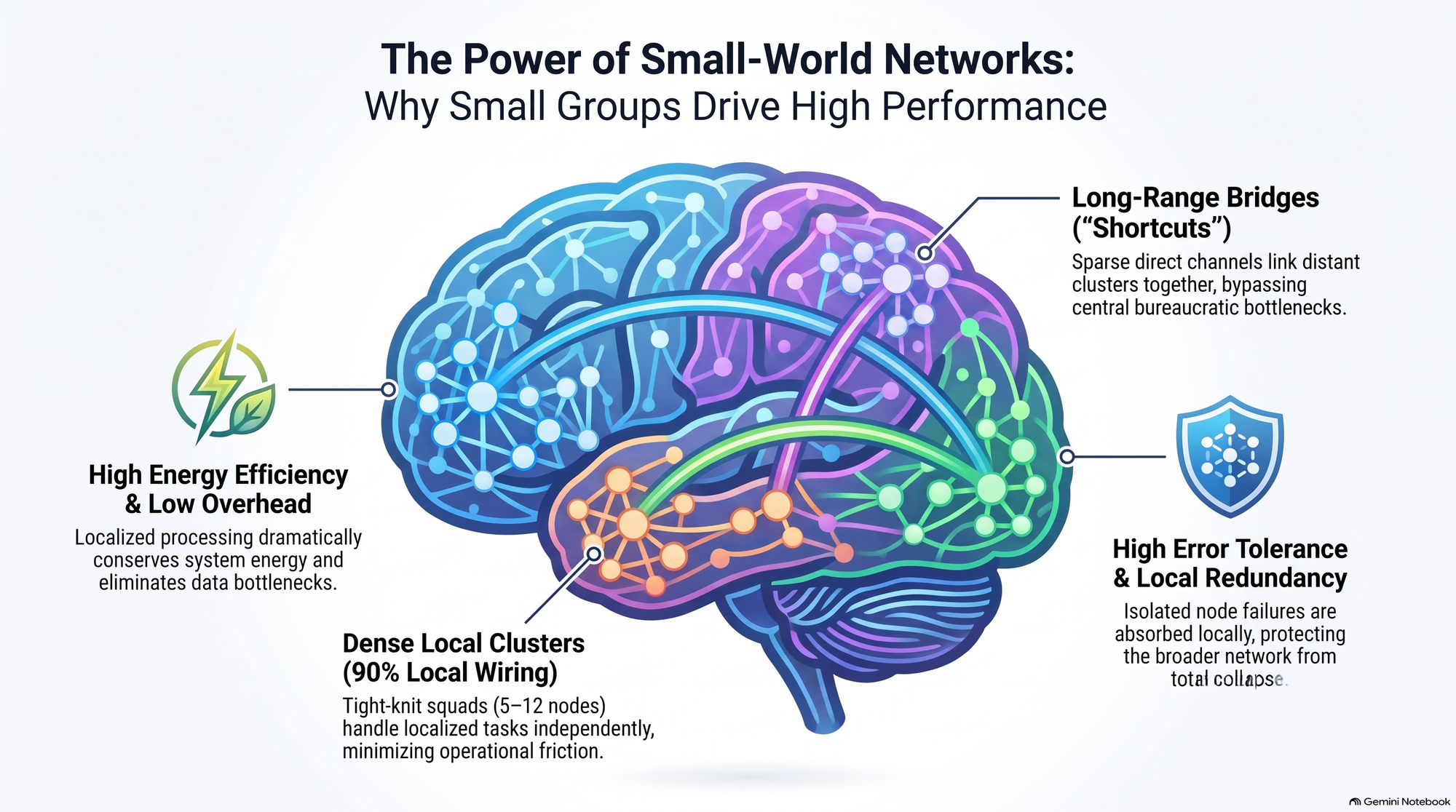
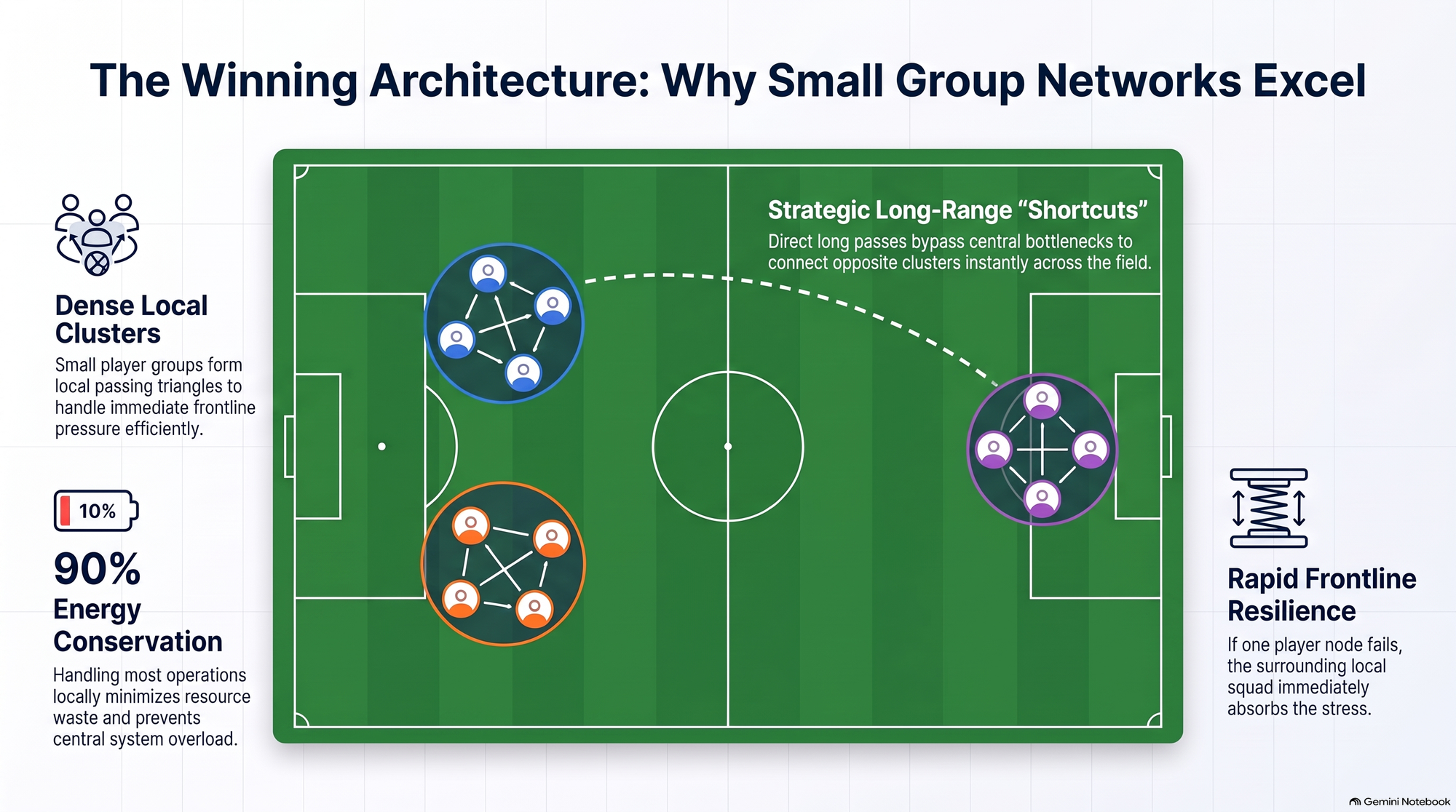
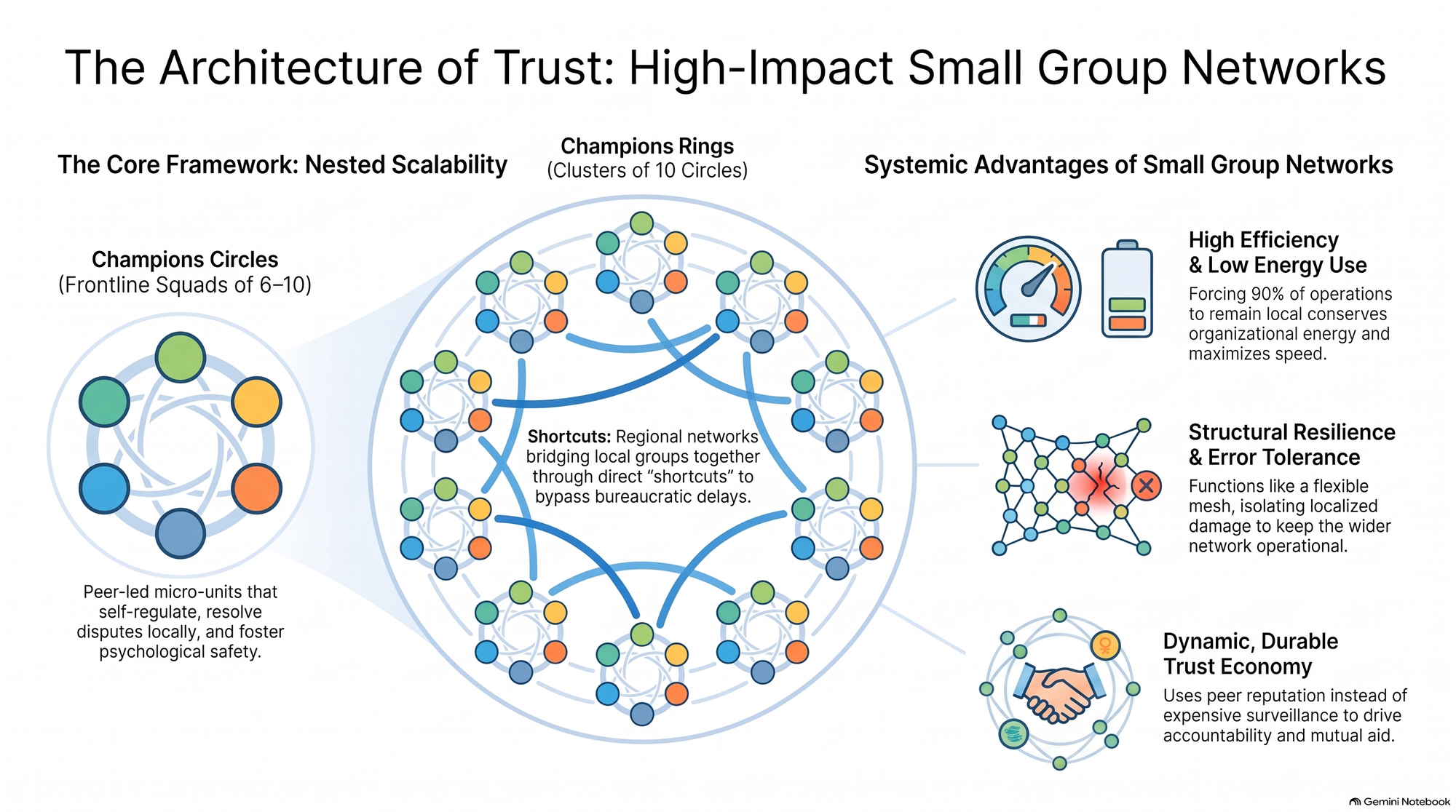
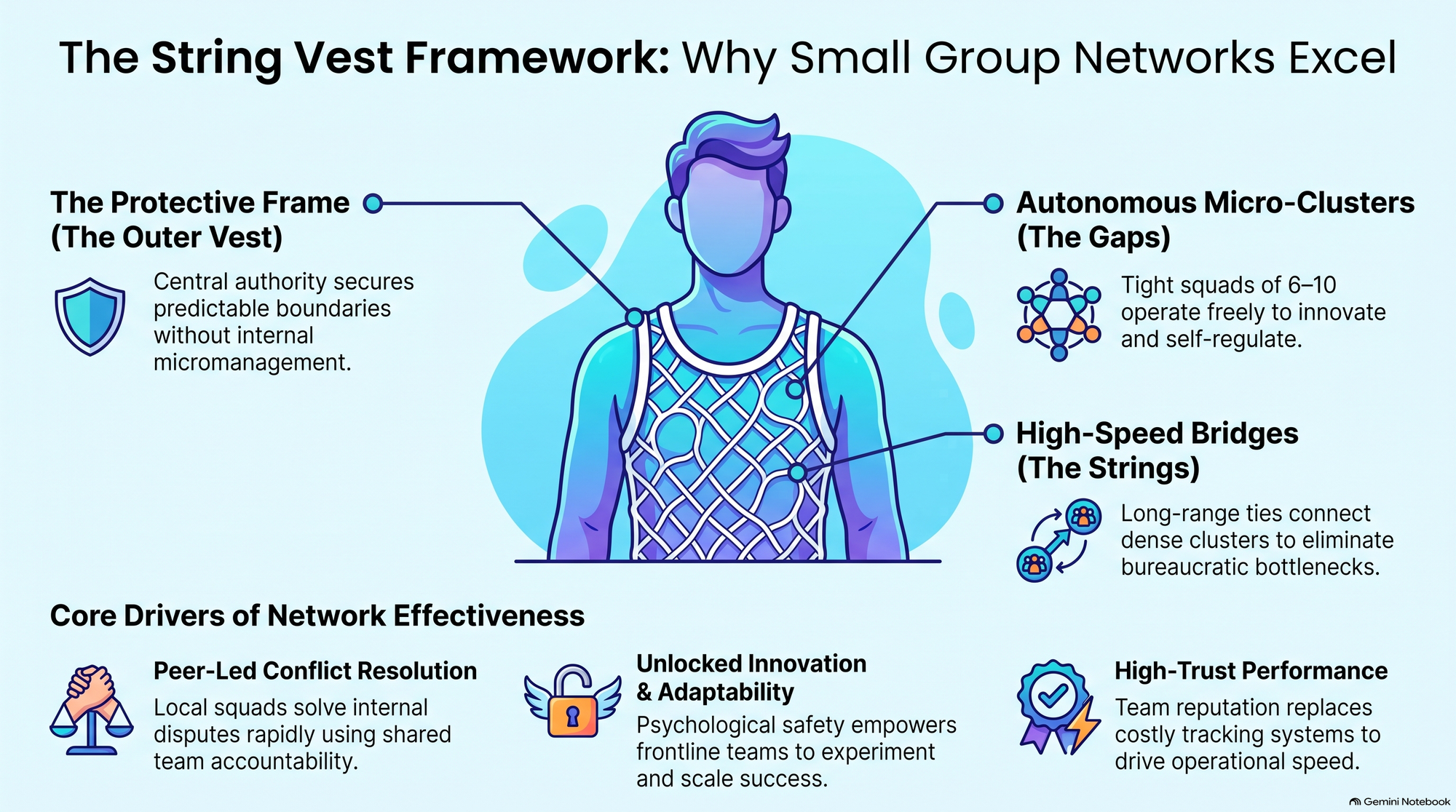
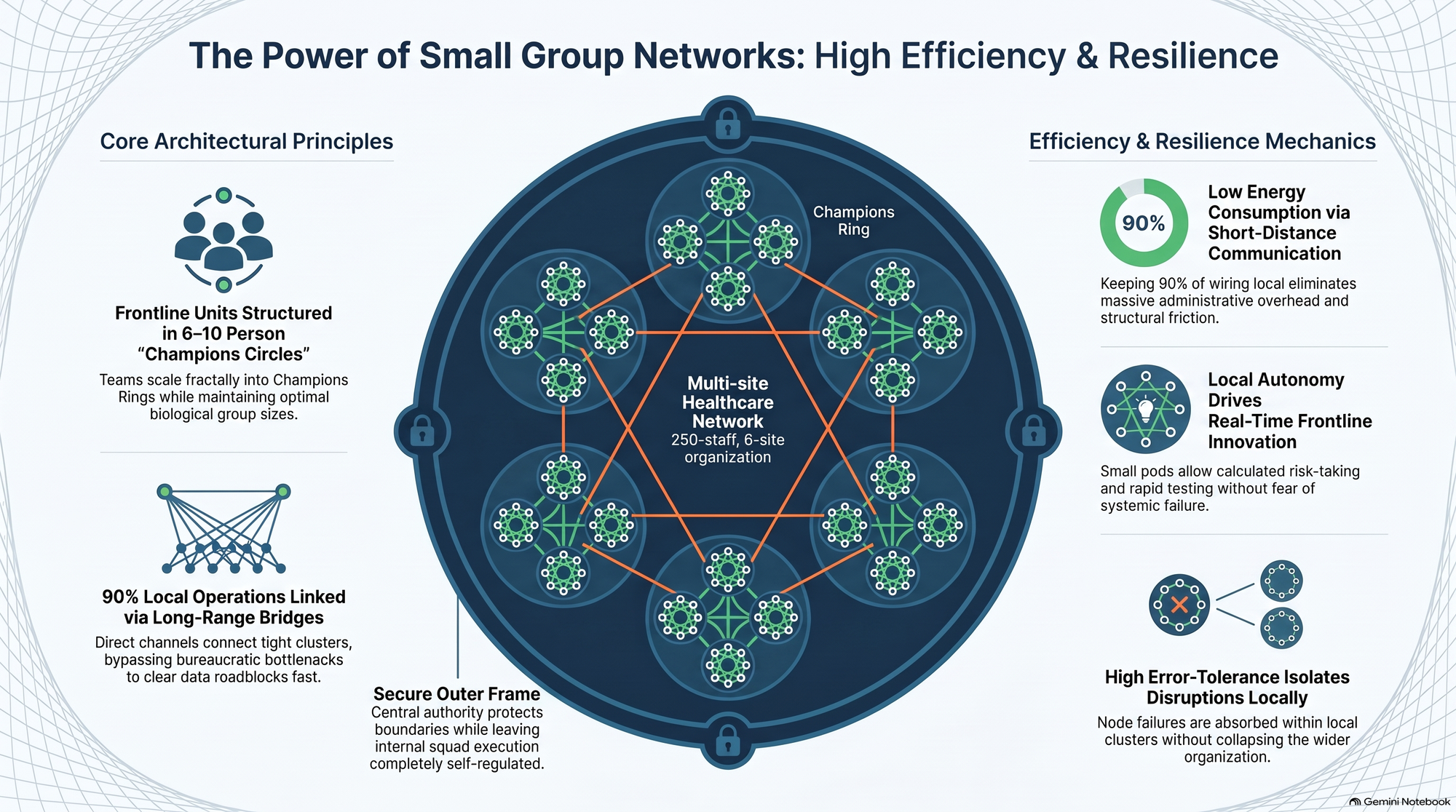
Illustrations of Small Group Networks in Biology, Thermodynamics and Organisations
Documents
These documents provide overall principles and examples of proven models.